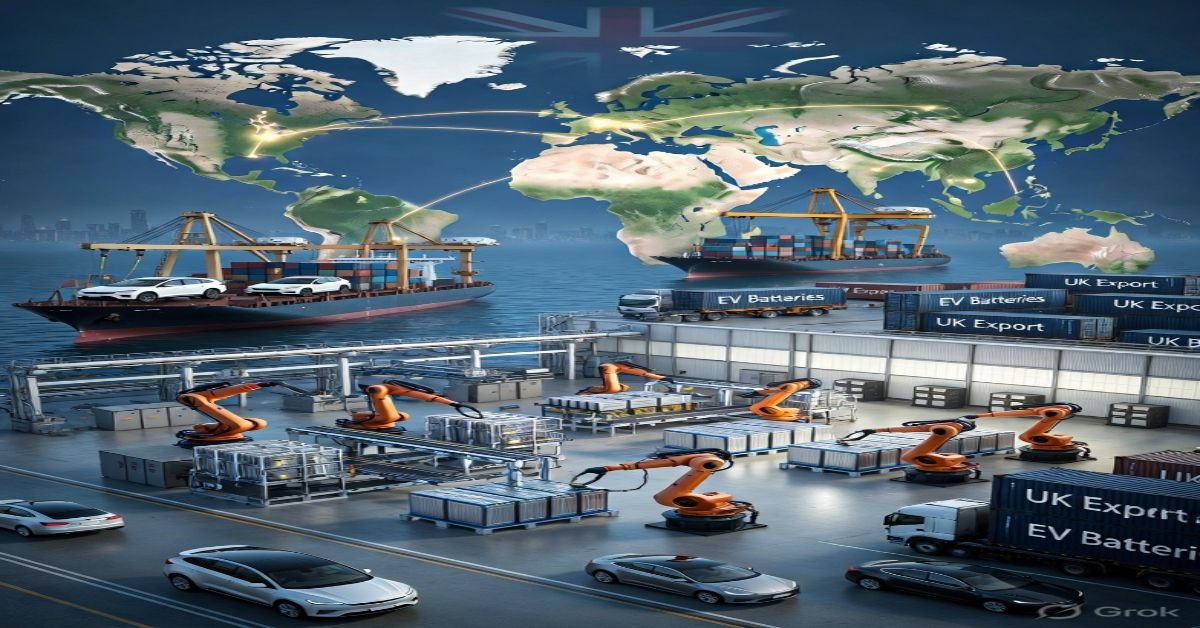
UK EV battery trade and export data sector is rapidly evolving, driven by the global transition toward clean mobility and energy storage. At the heart of this transformation lies the EV battery ecosystem—an intricate network of raw material sourcing, manufacturing, imports, exports, and recycling.
📊 Understanding the UK EV Battery Market Landscape
The EV battery market is a critical pillar of the UK’s automotive and energy transition strategy. Batteries account for 30–40% of an electric vehicle’s cost, making them central to both trade and industrial competitiveness.
The UK currently operates within a globalized battery supply chain, relying heavily on imports for battery cells, raw materials, and components.
Key Market Highlights
- The UK imports the majority of its battery components
- China remains the dominant global supplier
- Domestic production capacity is still developing
- Export potential is tied closely to automotive manufacturing
According to the UK government’s battery strategy, the country meets most of its battery demand through imports, with lithium-ion battery imports worth nearly £1.8 billion in 2022.
🔍 UK EV Battery Import Data
The UK is heavily import-dependent when it comes to EV batteries and related materials. This is primarily due to limited domestic gigafactory capacity.
Major Import Sources
| Country | Key Battery Supply Role | Estimated Share |
|---|---|---|
| China | Lithium-ion batteries, raw materials | High |
| Germany | Battery packs, automotive integration | Moderate |
| Japan | Advanced battery technology | Low–Moderate |
Import Trends
- China supplies nearly 50% of lithium-ion battery imports to the UK
- Imports have increased steadily alongside EV adoption
- The UK’s reliance on Asian markets creates supply chain risks
Why Imports Dominate
- Lack of large-scale battery manufacturing plants
- High capital cost of gigafactories
- Established Asian battery ecosystems
Read more:Local Council EV Charging Grants UK
📦 UK EV Battery Export Data
While the UK is import-heavy, it still plays a role in exports—primarily through vehicle exports rather than standalone battery exports.
Export Characteristics
- Batteries are often exported as part of EVs
- Key markets include the European Union and the United States
- Export volumes fluctuate with vehicle production levels
The UK exports around 80% of the vehicles it produces, demonstrating the export-oriented nature of its automotive industry.
UK Trade Overview (2025)
| Category | Value (£ Billion) | Growth Rate |
|---|---|---|
| Total Exports | 923.3 | +3.5% |
| Total Imports | 945.1 | +3.9% |
| Trade Deficit | -21.8 | Increased |
| Goods Exports | 377.5 | -2.2% |
| Goods Imports | 603.1 | +2.6% |
Source: UK Office for National Statistics
Key Insight
The UK continues to run a trade deficit in goods, which includes automotive and battery-related imports.
🌍 Global Context: Where the UK Stands
The global EV market is expanding rapidly, influencing battery trade patterns.
- Global EV production reached 17.3 million vehicles in 2024
- EV exports globally grew nearly 20% in 2024
- China accounts for over 70% of EV production
UK Position
-
Smaller production base compared to EU and China
- Declining EV production in 2024 (around 80,000 units)
- Strong dependency on international supply chains
⚡ EV Growth Driving Battery Trade
The rise in EV adoption directly impacts battery imports and trade.
UK EV Market Growth
- EV registrations reached record highs in 2026
- Market share is growing but still below government targets
- Over 160 EV models available in the UK market
EV Adoption Impact on Battery Trade
| Factor | Impact on Trade |
|---|---|
| Increased EV demand | Higher battery imports |
| Limited domestic supply | Trade deficit increases |
| Government incentives | Boosts import volumes |
| Gigafactory development | Future export potential |
🔗 UK–EU Battery Trade Relations
The European Union remains the UK’s most important trading partner for EVs and batteries.
Key Trade Insights
- Around 62% of UK vehicle exports go to the EU
- EU accounts for nearly 70% of UK vehicle imports by value
- Battery-electric vehicles represent a growing share of trade
Post-Brexit Challenges
- Rules of origin requirements
- Tariff risks on battery components
- Increased compliance costs
Read more:New Honda Electric Car 2026
🔋 Battery Recycling and Secondary Trade
Battery recycling is emerging as a critical component of the UK’s EV trade ecosystem.
Current Situation
- Over 23,000 used EV batteries are stockpiled in the UK
- Up to 90% are not yet recycled
Opportunities
- Export of recycled materials
- Domestic circular economy development
- Reduced reliance on raw material imports
📊 EV Battery Value Chain in the UK
| Stage | Current Status | Trade Impact |
|---|---|---|
| Raw Materials | Mostly imported | High import dependency |
| Cell Manufacturing | Limited capacity | Growing investment |
| Pack Assembly | Moderate capability | Domestic value addition |
| Recycling | Underdeveloped | Export potential |
🏭 Investment in UK Battery Manufacturing
The UK government is actively investing in domestic battery production to reduce reliance on imports.
Key Initiatives
- Gigafactory development projects
- Public-private partnerships
- Funding for battery R&D
These investments aim to strengthen the UK’s position in the global EV battery supply chain.
🚧 Challenges in UK EV Battery Trade
1. Heavy Import Dependency
The UK relies on global suppliers, especially Asia, for battery materials and cells.
2. Limited Domestic Production
Compared to the EU and China, the UK’s battery manufacturing capacity is still developing.
3. Trade Deficit
The UK’s goods trade deficit continues to widen, reflecting higher imports than exports.
4. Supply Chain Risks
Geopolitical tensions and trade disruptions can impact battery availability.
🚀 Opportunities for Growth
Despite challenges, the UK EV battery sector presents significant opportunities:
✔ Expansion of Gigafactories
Local production can reduce imports and boost exports
✔ Recycling Industry Development
Turning waste into valuable export materials
✔ Innovation in Battery Technology
Solid-state batteries and energy storage solutions
✔ Strong EV Demand
Growing domestic and international markets
Read more:EV cars in Malaysia below RM100K
📈 Future Outlook: UK EV Battery Trade
The UK’s EV battery trade is expected to evolve significantly over the next decade.
Short-Term (2025–2030)
- Continued reliance on imports
- Gradual increase in domestic production
- Rising EV demand driving trade volumes
Long-Term (2030–2040)
- Potential for export growth
- Circular battery economy development
- Reduced trade deficit in battery sector
✅ Conclusion
UK EV battery trade and export data is at a critical turning point. While the country currently relies heavily on imports—particularly from Asia—it is actively working to build domestic capacity and reduce supply chain vulnerabilities.
With rising EV adoption, increasing government support, and growing investment in battery manufacturing and recycling, the UK has the potential to transform from a net importer to a competitive player in global EV battery trade.
1 thought on “UK EV battery trade and export data”