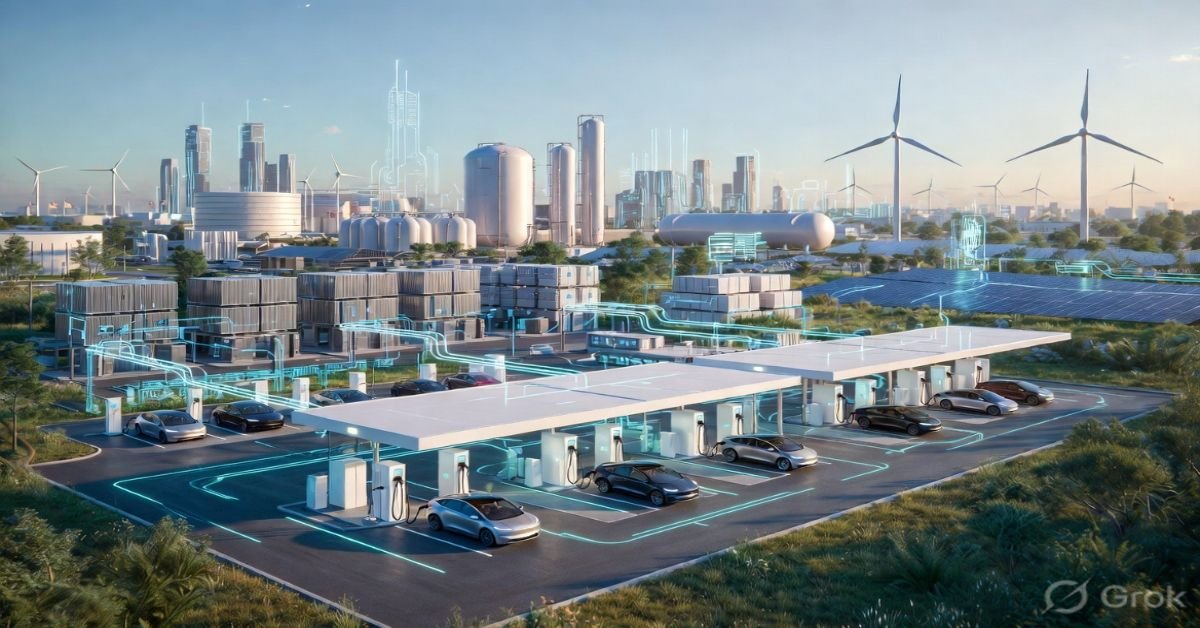
The United Kingdom is rapidly emerging as a global leader in electric vehicle (EV) energy storage innovation, driven by ambitious net-zero targets, strong government backing, and cutting-edge research. As EV adoption accelerates, the need for efficient, scalable, and sustainable energy storage solutions has become critical.
Understanding EV Energy Storage: Why It Matters
Energy storage is the backbone of the EV ecosystem. It ensures that electricity generated—especially from renewable sources like wind and solar—can be stored and used efficiently when needed.
Without advanced storage systems:
- Renewable energy would go to waste
- Grid instability would increase
- EV adoption would slow down
The UK recognizes this challenge and is investing heavily in next-generation solutions.
📊 According to recent industry analysis, the UK’s energy storage capacity is expected to triple by 2030, potentially reaching 50 GW by mid-century, highlighting its central role in the clean energy transition .
Key Breakthroughs in UK EV Energy Storage (2025–2026)
1. High-Density Hydropower Storage Revolution
One of the most exciting discoveries is the development of high-density hydropower systems.
- Uses a dense fluid heavier than water
- Works on gentle slopes, unlike traditional dams
- Can store and release renewable energy efficiently
A pilot project in Devon has already demonstrated:
- Power output sufficient for 400 homes annually
- Potential for scalable deployment across the UK
Why it matters for EVs:
This technology provides long-duration storage, ensuring EV charging networks have consistent power even during low renewable generation.
2. Liquid Air Energy Storage (LAES) Expansion
The UK is pioneering Liquid Air Energy Storage (LAES) systems, led by major investments.
Key features:
- Air is cooled into liquid form and stored
- Reheated to generate electricity when needed
- No reliance on rare battery materials
A major project in Scotland is integrating:
- LAES technology
- Grid stabilization systems
- Renewable energy balancing infrastructure
Impact on EV ecosystem:
- Supports mass EV charging demand
- Reduces dependence on lithium-ion batteries
- Enables grid-scale storage for fast charging networks
3. Ultra-Fast Charging Battery Technology
UK-based innovators are pushing the limits of charging speed and battery performance.
A breakthrough by Cambridge-based companies shows:
- EV batteries can charge from 10% to 80% in under 5 minutes
- Uses advanced graphite anode systems
- Targets commercial EV and heavy-duty vehicles
Implications:
- Eliminates “range anxiety”
- Makes EV charging comparable to petrol refueling
- Requires advanced storage systems to handle power demand
4. Semi-Solid-State Battery Advancements
The UK is also seeing the introduction of semi-solid-state batteries, a step toward full solid-state technology.
Benefits include:
- Higher energy density
- Improved safety
- Better performance in cold climates
These batteries:
- Use significantly less liquid electrolyte
- Offer longer lifespan and faster charging
This innovation is expected to enter mass-market EVs by 2026, marking a major shift in battery design .
5. Sodium-Ion and Alternative Battery Chemistries
While lithium-ion dominates today, new chemistries are emerging:
- Sodium-ion batteries: cheaper, abundant materials
- Metal-air batteries: higher theoretical energy density
- Flow batteries: ideal for grid storage
Research shows these technologies:
- Improve sustainability
- Reduce reliance on rare minerals
- Expand storage capabilities
Future outlook:
Sodium-ion batteries are already entering EV markets globally, and the UK is expected to adopt similar solutions soon.
Read more:New Honda Electric Car 2026
Large-Scale Energy Storage Projects in the UK
1. Mega Battery Energy Storage Systems (BESS)
The UK is building some of Europe’s largest battery hubs.
| Project Name | Location | Capacity | Key Feature |
|---|---|---|---|
| Thorpe Marsh Green Energy Hub | South Yorkshire | 3.1 GWh | One of Europe’s largest battery storage systems |
| Grid-scale BESS Expansion | Nationwide | Growing rapidly | Supports EV charging and renewable integration |
The Thorpe Marsh project alone will deliver:
- 1.4 GW power capacity
- Enough storage to stabilize large-scale EV charging demand
2. Long-Duration Energy Storage (LDES) Projects
The UK government is backing multiple LDES initiatives:
| Project | Type | Duration | Status |
|---|---|---|---|
| Coire Glas | Pumped hydro | Long-duration | Approved for funding |
| Earba Storage | Pumped storage | 22 hours | Under evaluation |
These projects:
- Store energy for hours or even days
- Ensure grid reliability during peak EV demand
3. Integrated EV Charging + Storage Systems
New EV charging stations are now integrating local energy storage.
Example innovations:
- On-site battery systems
- Load balancing technology
- Reduced grid stress
A recently launched system:
- Stores energy locally
- Smooths peak demand
- Improves charging efficiency
Smart Energy Storage: The Role of AI and Digital Systems
Modern EV storage isn’t just about batteries—it’s about intelligence.
Key developments:
- AI-powered battery management systems
- Predictive analytics for energy demand
- Digital twins for optimization
Research highlights:
- Improved battery lifespan
- Enhanced safety
- Efficient energy distribution
Vehicle-to-Grid (V2G): Turning EVs into Energy Assets
One of the most transformative discoveries is Vehicle-to-Grid (V2G) technology.
How it works:
- EVs store electricity
- Feed energy back to the grid when needed
UK trends show:
- Commercial V2G deployment is increasing
- Smart charging systems are becoming mainstream
Benefits:
- Reduces energy costs
- Stabilizes the grid
- Turns EVs into mobile storage units
Government Policies Driving Innovation
The UK government is playing a critical role through:
- Creation of Great British Energy (GBE)
- Funding for long-duration storage projects
- Net-zero carbon targets
GBE focuses on:
- Investing in clean energy storage
- Supporting large-scale infrastructure
- Accelerating EV adoption
Challenges in EV Energy Storage
Despite rapid progress, challenges remain:
1. Infrastructure Limitations
- Grid capacity constraints
- Slow charger deployment in some regions
2. High Costs
- Advanced batteries still expensive
- Scaling new technologies requires investment
3. Supply Chain Risks
- Dependence on critical minerals
- Need for sustainable alternatives
4. Cybersecurity Concerns
- Increasing digitalization of EV systems
- Risk of remote interference
Read more:EV Battery Degradation Solutions UK
Future Trends to Watch (2026–2035)
1. Solid-State Batteries
- Higher range
- Faster charging
- Improved safety
2. Hydrogen Energy Storage
- Long-term storage solution
- Ideal for heavy transport
3. Gravity and Mechanical Storage
- Low environmental impact
- Scalable infrastructure
4. Decentralized Energy Systems
- Community-based storage
- Local EV charging hubs
5. Hybrid Storage Systems
- Combining batteries + LAES + hydro
- Maximizing efficiency and reliability
Expert Insights: Why the UK Leads in EV Storage Innovation
The UK’s leadership is driven by:
- Strong policy support
- Advanced research institutions
- Private sector investment
- Rapid EV adoption (nearly one in four new cars electric in 2025)
Industry experts believe the UK is transitioning from:
- “Innovation phase” → “Execution phase” in energy storage deployment
Conclusion
The UK is at the forefront of EV energy storage discoveries, combining cutting-edge technology with large-scale infrastructure development. From high-density hydropower and liquid air storage to ultra-fast charging batteries and AI-driven systems, the country is redefining how energy is stored and used.
These advancements are not just improving EV performance—they are building the foundation for a fully electrified, sustainable future.
1 thought on “Latest EV energy storage discoveries UK”