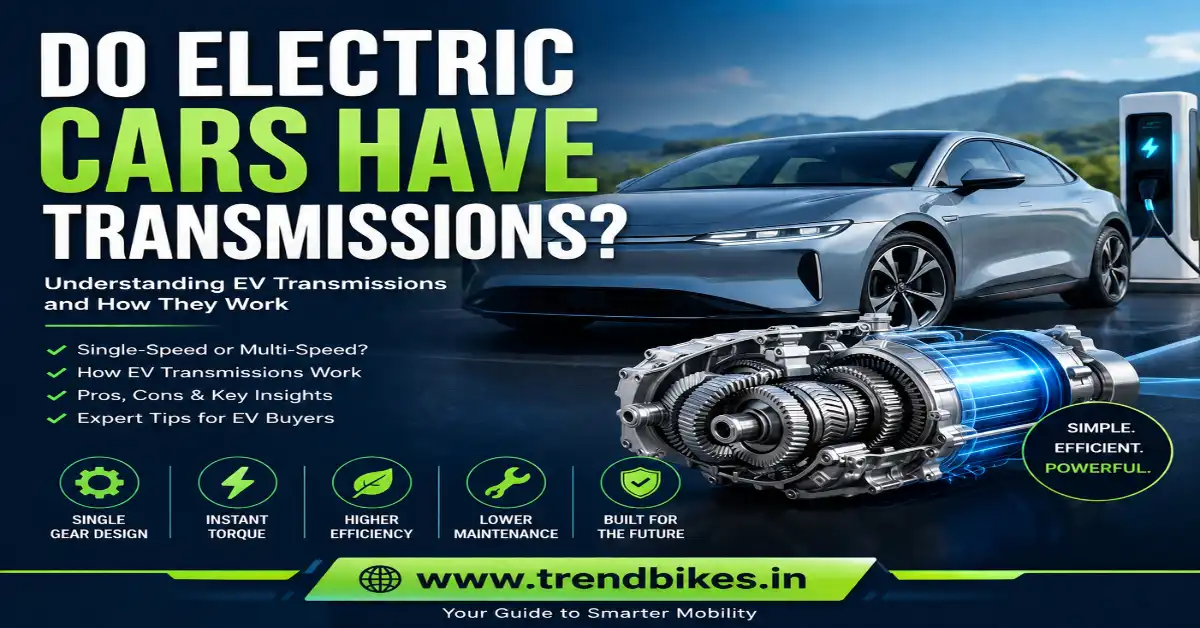
Do Electric Cars Have Transmissions: Unlike traditional internal combustion engine (ICE) vehicles that rely on multi-speed automatic or manual transmissions, most electric cars use a single-speed transmission. This simpler design works because electric motors produce maximum torque almost instantly and operate efficiently across a wide range of speeds.
In this guide, you’ll learn exactly how EV transmissions work, why they differ from conventional gearboxes, and whether some electric vehicles actually use multiple gears.
Why Do Electric Cars Have Transmissions?
Every vehicle needs a way to transfer power from the motor or engine to the wheels.
A transmission helps:
- Deliver power efficiently
- Control wheel speed
- Maximize performance
- Improve driving comfort
Gasoline engines operate efficiently only within a limited RPM range, requiring multiple gears.
Electric motors, however, produce usable power across a much wider RPM range, making multiple gears unnecessary in most situations.
How Does an Electric Car Transmission Work?
Most electric vehicles use a single-speed reduction gearbox.
Instead of shifting through six, eight, or ten gears like conventional cars, the electric motor spins rapidly while the reduction gear lowers rotational speed before sending power to the wheels.
The Process
- Battery supplies electricity.
- Electric motor spins.
- Reduction gear lowers RPM.
- Differential distributes power.
- Wheels move.
The result is smooth, continuous acceleration without gear shifts.
Why Don’t Most Electric Cars Need Multiple Gears?
Several engineering advantages make a single-speed transmission possible.
Instant Torque
Electric motors generate nearly maximum torque from zero RPM.
Unlike gasoline engines, there is no waiting for the engine to build power.
Wide RPM Range
Many EV motors operate efficiently between:
- 0 RPM
- 15,000 RPM
- 18,000 RPM
- Even over 20,000 RPM in performance models
This wide operating range eliminates frequent gear changes.
Simpler Drivetrain
A single-speed gearbox contains fewer moving parts, reducing:
- Maintenance
- Mechanical losses
- Manufacturing complexity
- Repair costs
Do Any Electric Cars Have Multiple-Speed Transmissions?
Yes.
Although uncommon, several manufacturers have introduced multi-speed transmissions to improve:
- High-speed efficiency
- Performance
- Towing capability
- Top speed
Examples
| Electric Vehicle | Transmission |
|---|---|
| Porsche Taycan | Two-speed rear transmission |
| Audi e-tron GT | Two-speed |
| Mercedes AMG EV Concepts | Multi-speed technology under development |
| Some Commercial EVs | Multi-speed gearbox |
The second gear helps improve highway efficiency while maintaining strong acceleration.
Single-Speed vs Multi-Speed EV Transmissions
| Feature | Single-Speed | Multi-Speed |
|---|---|---|
| Complexity | Low | Higher |
| Maintenance | Very Low | Moderate |
| Cost | Lower | Higher |
| Smoothness | Excellent | Good |
| Highway Efficiency | Good | Better |
| Performance | Excellent | Excellent+ |
Most everyday drivers won’t notice a need for multiple gears.
Advantages of Single-Speed EV Transmissions
Lower Maintenance
Without clutches, torque converters, or numerous gears, there are fewer components to wear out.
Smooth Driving
No gear changes mean:
- No shift shock
- Continuous acceleration
- Comfortable driving
Better Reliability
Simpler systems generally last longer and require fewer repairs.
Lower Manufacturing Cost
Fewer components reduce production expenses.
Are Electric Cars Automatic?
Yes.
Nearly all electric cars operate similarly to automatic vehicles.
Drivers simply select:
- Park (P)
- Reverse (R)
- Neutral (N)
- Drive (D)
Some models also include:
- Sport Mode
- Eco Mode
- Regenerative Braking Levels
There is no clutch pedal and no manual shifting in most EVs.
What Is Regenerative Braking?
Regenerative braking is one of the biggest differences between EVs and traditional cars.
Instead of wasting energy as heat, the electric motor acts as a generator during deceleration.
Benefits include:
- Extended driving range
- Reduced brake wear
- Improved efficiency
- Better battery charging while driving
- Do Electric Cars Have Transmissions
Many EVs even allow one-pedal driving, where lifting off the accelerator slows the vehicle significantly.
Can Electric Cars Have Manual Transmissions?
Technically, yes.
A few manufacturers have experimented with manual gearboxes or simulated manual shifting for driving enjoyment.
Examples include:
- Experimental EV conversions
- Concept sports cars
- Simulated manual software systems
However, true manual transmissions provide little practical benefit because electric motors do not require gear changes to stay in their optimal power range.
Common Myths About EV Transmissions
Electric Cars Have No Transmission
Reality: Every EV has a transmission, but it is usually a single-speed reduction gearbox.
No Gears Means Poor Performance
Reality:
Electric cars often outperform gasoline vehicles due to instant torque.
EV Gearboxes Frequently Fail
Reality:
Single-speed gearboxes are among the most reliable drivetrain components.
Multi-Speed Is Always Better
Reality:
For everyday driving, single-speed transmissions offer excellent efficiency and simplicity.
Real-World Example
Imagine two cars leaving a traffic light. Do Electric Cars Have Transmissions
Gasoline Car
- Engine revs
- First gear
- Shift to second
- Shift to third
Acceleration pauses slightly during each gear change.
Electric Car
The motor delivers full torque immediately.
The car accelerates continuously without interruptions.
This smooth power delivery is one reason many drivers prefer EVs.
Mini Case Study: Why Porsche Uses Two Gears
Porsche designed the Taycan with a two-speed transmission because:
- First gear improves launch acceleration.
- Second gear enhances highway efficiency.
- High-speed performance improves significantly.
For luxury performance vehicles, the additional complexity is worthwhile.
For most commuters, a single-speed gearbox remains the better solution.
Pros and Cons of EV Transmissions
Pros
- Extremely reliable
- Minimal maintenance
- Smooth acceleration
- Instant torque
- Lower repair costs
- High efficiency
- Quiet operation
Cons
- Less engaging for manual-driving enthusiasts
- Performance EVs may benefit from extra gears
- Replacement can be expensive if damaged
- Specialized servicing may be required
Mistakes to Avoid When Learning About EVs
Assuming EVs Have No Transmission
Every electric car has some form of gearbox.
Comparing EV Motors to Gasoline Engines
They operate completely differently.
Ignoring Regenerative Braking
Learning to use regenerative braking improves efficiency.
Believing More Gears Always Mean Better Performance
Electric motors often perform best with fewer gears.
Expert Tips Before Buying an Electric Car
- Test-drive multiple EV models.
- Learn how regenerative braking feels.
- Understand battery range instead of focusing only on horsepower.
- Check warranty coverage for the drivetrain.
- Research charging infrastructure near your home.
- Compare single-motor and dual-motor systems.
- Consider long-term maintenance savings.
Conclusion
Do Electric Cars Have Transmissions Yes, they do—but they are much simpler than those found in gasoline-powered vehicles. Most electric cars rely on a single-speed transmission because electric motors produce instant torque and operate efficiently across a broad speed range.
While a few high-performance EVs use two-speed gearboxes for enhanced acceleration and highway efficiency, the vast majority of electric vehicles benefit from the reliability, smoothness, and low maintenance of a single-speed reduction gearbox.
If you’re considering an electric vehicle, understanding its drivetrain can help you appreciate why EVs deliver such effortless performance and reduced ownership costs.
Ready to explore the world of electric mobility? Compare EV models, take a test drive, and experience the smooth power delivery of a modern electric drivetrain for yourself.
Frequently Asked Questions (FAQs)
1. Do electric cars have transmissions?
Yes. Most electric cars use a single-speed transmission that transfers power from the electric motor to the wheels without multiple gear changes.
2. Why don’t electric cars need multiple gears?
Electric motors deliver maximum torque from very low speeds and operate efficiently across a wide RPM range, eliminating the need for several gears.
3. Do electric cars have automatic transmissions?
Most EVs function like automatics, with simple selections such as Park, Reverse, Neutral, and Drive.
4. Which electric cars have two-speed transmissions?
Performance models such as the Porsche Taycan and Audi e-tron GT use two-speed gearboxes to improve acceleration and high-speed efficiency.
5. Can electric cars have manual transmissions?
Technically yes, but they are rare because manual gear changes provide little practical advantage in an electric drivetrain.
6. Is an EV transmission easier to maintain?
Yes. Single-speed gearboxes have fewer moving parts, reducing maintenance needs and improving long-term reliability.
7. What happens if an EV transmission fails?
Although uncommon, a failed gearbox typically requires professional repair or replacement. Most EV manufacturers provide drivetrain warranties that cover major components.
8. Does regenerative braking replace the transmission?
No. Regenerative braking recovers energy during deceleration, while the transmission transfers power from the motor to the wheels.
9. Are electric cars faster because they have one gear?
They often accelerate quickly because the electric motor provides instant torque, not simply because they use one gear.
10. Will future electric cars use more gears?
Some performance and commercial EVs may adopt multi-speed transmissions for specific benefits, but single-speed systems are expected to remain the standard for most passenger electric cars.